
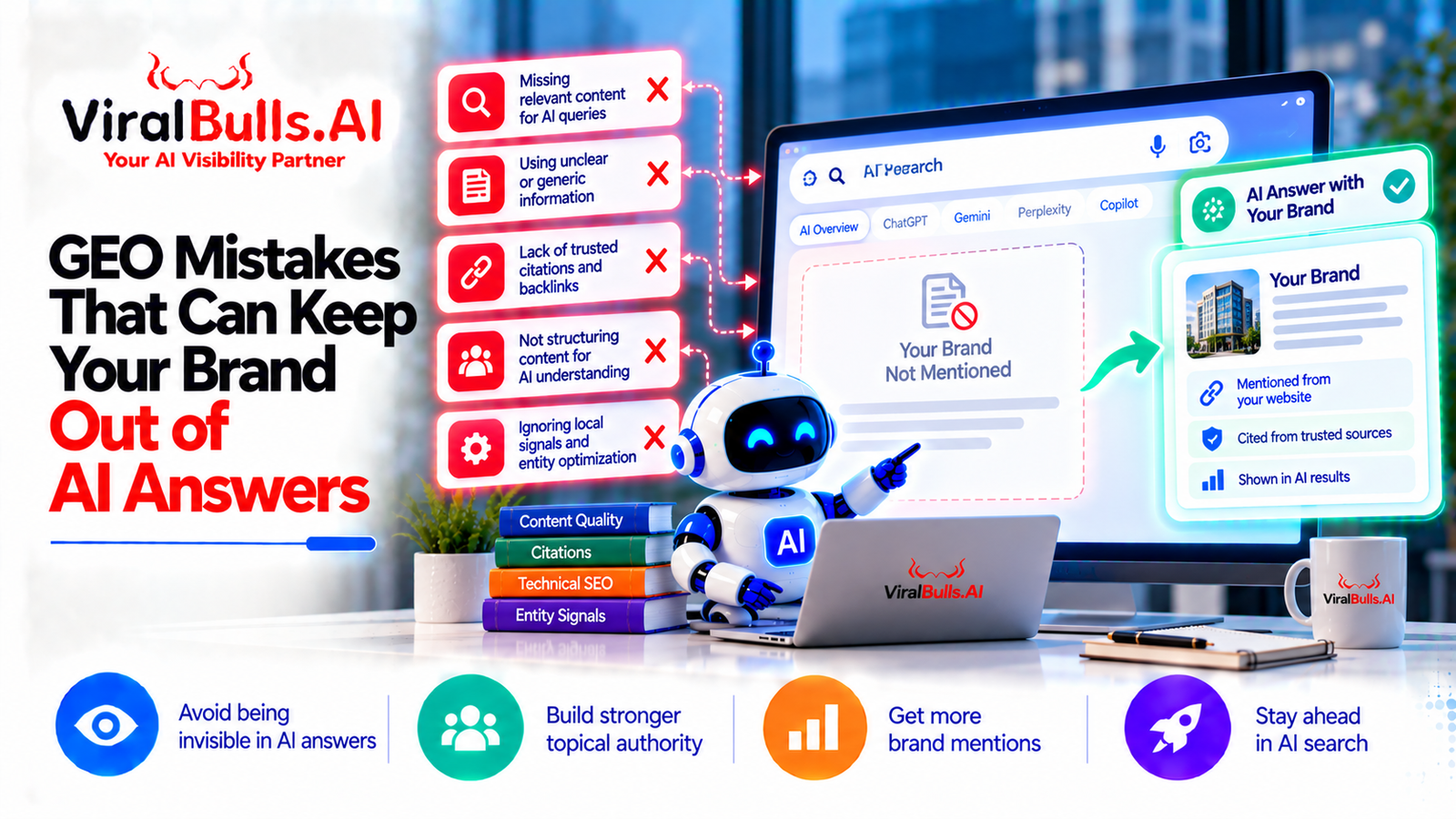
Ask ChatGPT for the best digital marketing agency in your city. Ask Perplexity which skincare brand is worth trying. Ask Google’s AI Overview how to choose salon software. Now notice something: the answer names only a few brands, and everyone else simply doesn’t exist.
That is the new reality of search. Buyers increasingly trust a single, synthesized AI answer instead of scrolling through ten blue links. If your brand isn’t part of that answer, you are invisible at the exact moment a customer decides. The frustrating part? Most brands aren’t left out because they are weak. They are left out because of a handful of fixable Generative Engine Optimization (GEO) mistakes.
Let’s walk through them, so you can stop being overlooked and start being recommended.
What Is GEO, and Why Does It Matter Now?
GEO is the practice of optimizing your brand’s content, reputation and technical setup so that AI platforms such as ChatGPT, Gemini, Perplexity, Claude and Google AI Overviews can find, understand, trust and cite you. Traditional SEO fights for a ranking position. GEO fights for a place inside the answer itself.
The two are related, but they are not identical. AI engines reward clarity, credibility, structure and consistency across the web. A brand can rank on page one of Google and still never be mentioned by an AI assistant. If you want lasting AI search visibility, you need to avoid the mistakes below.
8 GEO Mistakes That Keep Brands Out of AI Answers
1. Treating GEO as “SEO with a new name”
Many teams simply reuse their old keyword-stuffing playbook and hope for the best. AI models don’t count keyword density; they interpret meaning. They look for direct, well-supported answers to real questions. If your pages are written to please an algorithm from 2015, they won’t earn a citation in 2026.
The fix: write for questions and intent. Lead with a clear answer, then support it with context, examples and data.
2. Publishing thin, generic content
If your blog says what fifty other blogs already say, AI has no reason to choose yours. Generative engines favor content that adds something new: original data, first-hand experience, expert opinion or a distinct point of view. Generic, mass-produced articles blend into the background.
The fix: add proof. Include case studies, client results, screenshots, survey numbers and named expert insights that can’t be found elsewhere.
3. Ignoring E-E-A-T signals
AI systems try to avoid recommending unreliable sources, so they lean on signals of Experience, Expertise, Authoritativeness and Trustworthiness. Anonymous posts, missing author bios and vague “About” pages send the wrong message.
The fix: show real authors with credentials, cite reputable sources, display testimonials and awards, and make your company details easy to verify.
4. Skipping structured data and clean formatting
AI crawlers read your page differently than humans do. Walls of unbroken text, missing headings and no schema markup make it harder for machines to extract facts. Without Organization, FAQ, Product, Review or Article schema, you are leaving your meaning open to guesswork.
The fix: use clear H2 and H3 headings, short paragraphs, bullet lists, tables and proper schema markup so your key facts are easy to lift.
5. Being inconsistent across the web
AI models build their understanding of your brand from many sources at once: your website, Google Business Profile, LinkedIn, directories, reviews and press mentions. If your name, services, location or descriptions differ from one place to the next, the model becomes uncertain, and uncertain brands don’t get recommended.
The fix: audit every profile and align your brand name, description, offerings and contact details everywhere.
6. Having no third-party mentions or reviews
Here is a hard truth: AI engines rarely trust a brand that only talks about itself. They pay close attention to what others say, including news articles, industry roundups, Reddit discussions, review platforms and expert lists. No external mentions means no external validation.
The fix: pursue digital PR, guest contributions, podcast appearances and genuine customer reviews. Earn mentions in places AI already reads.
7. Blocking AI crawlers by accident
Sometimes the problem is purely technical. A restrictive robots.txt file, aggressive security settings, heavy JavaScript rendering or slow page speed can stop AI bots from ever reading your content. If they can’t crawl you, they can’t cite you.
The fix: review your robots.txt, confirm that major AI crawlers are allowed, and make sure your important content loads as plain, accessible HTML.
8. Never measuring AI visibility
You can’t improve what you don’t track. Many brands check Google rankings weekly but have never asked an AI assistant about their own category. As a result, they don’t know whether they’re being mentioned, misrepresented or ignored completely.
The fix: build a list of 20 to 30 buyer questions and test them monthly across ChatGPT, Gemini, Perplexity and Google AI Overviews. Record who gets mentioned, which sources get cited and where the gaps are.
A Quick GEO Health Checklist
Before your next content sprint, ask yourself:
- Answer-first: Does each page answer its main question in the first few lines?
- Proof: Do we include original data, examples or expert input?
- Trust: Are authors, credentials and sources clearly visible?
- Structure: Are headings, lists and schema markup in place?
- Consistency: Is our brand described the same way everywhere online?
- Authority: Are credible third parties mentioning us?
- Access: Can AI crawlers actually read our site?
Turn Your Brand Into the Answer
AI search isn’t a distant trend; it is already shaping how customers discover, compare and choose. The brands that show up in AI answers today are building a compounding advantage, because every mention makes the next one more likely.
The good news is that none of these mistakes is permanent. Start with one or two fixes this week, such as tightening your key pages and auditing your brand profiles, then build from there. Small, consistent improvements add up faster than you might expect.
At Viralbulls AI, we help brands become visible where their customers are now looking. If you’d like to know how your brand appears in AI answers today, reach out for a GEO visibility audit and turn those blind spots into opportunities.
Frequently Asked Questions
What does GEO stand for?
GEO stands for Generative Engine Optimization. It is the process of optimizing your content and online presence so AI tools like ChatGPT, Gemini and Perplexity can understand, trust and cite your brand in their answers.
How is GEO different from SEO?
SEO aims to rank your pages in search results, while GEO aims to get your brand mentioned or cited inside AI-generated answers. They share foundations such as quality content and technical health, but GEO puts extra weight on clarity, structured data, credibility and third-party mentions.
How long does it take to appear in AI answers?
There is no fixed timeline. Technical fixes can show results within weeks, while authority-building through reviews, PR and quality content usually takes a few months. Consistency matters more than speed.
Do small businesses need GEO?
Yes. AI assistants often answer local and niche questions, such as “best salon near me” or “top SEO agency for startups.” Smaller brands with clear, consistent and well-reviewed profiles can absolutely earn a spot.
Can I track whether my brand appears in AI answers?
You can. Start manually by asking AI tools the questions your customers ask, then log the results each month. Dedicated GEO tracking tools can also automate this and highlight which sources AI relies on.
Will GEO replace SEO?
Not entirely. AI engines still rely on high-quality web content, and many use search indexes to find it. The smartest approach is to treat SEO and GEO as partners in one visibility strategy.