A business owner hears that competitors are using AI for content, advertising, search, automation, and lead generation. The natural response is to start adding tools.
Soon the company has an AI writer, chatbot, ad generator, automation platform, and reporting assistant. Yet leads are not improving because the tools were added without one connected strategy.
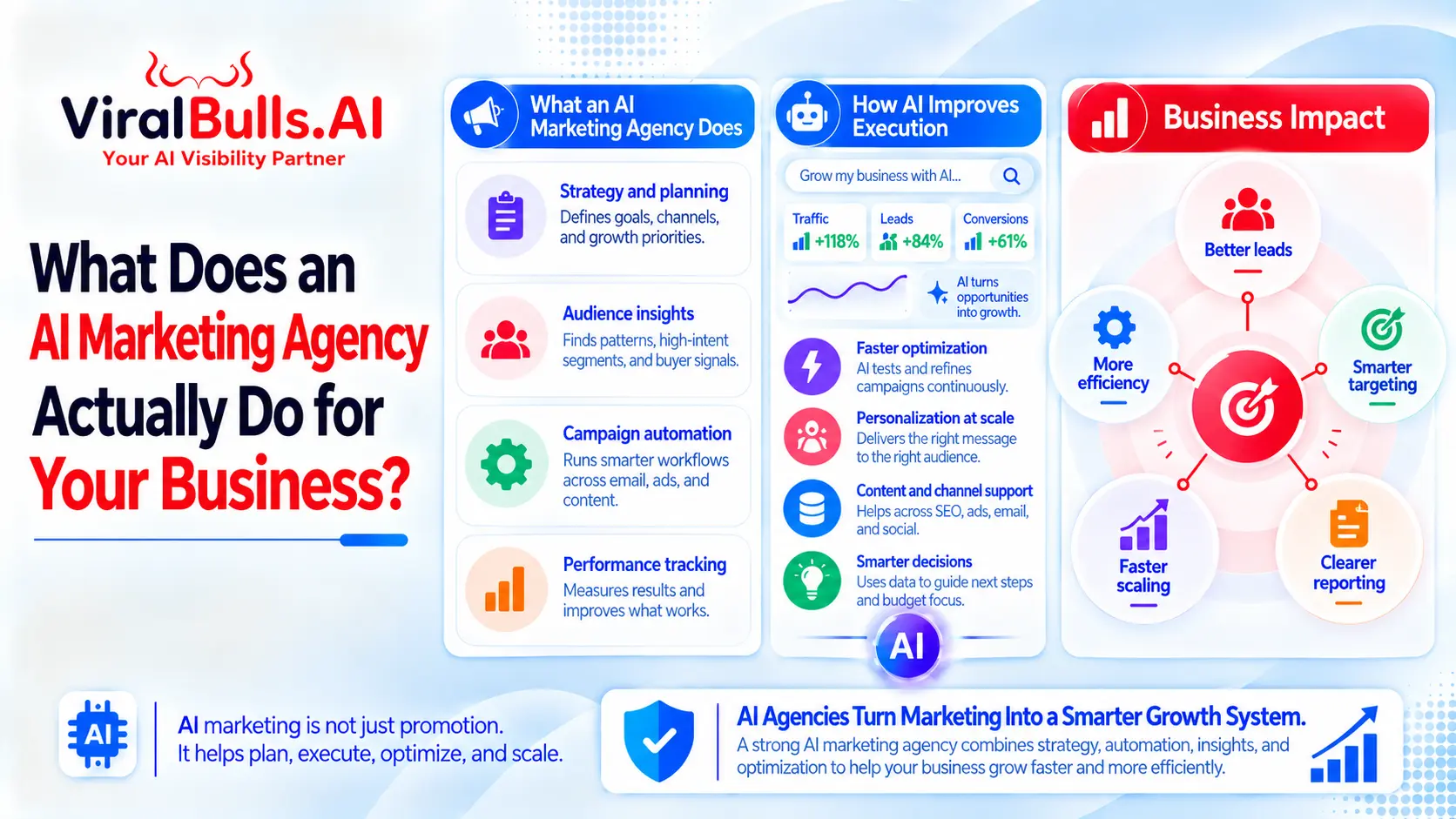
An AI marketing agency should solve that problem. Its role is not to sell access to tools. It is to connect business goals, customer insight, creative strategy, data, platforms, and AI-assisted execution into a measurable growth system.
The Agency Begins with the Business Problem
Before recommending AI, the agency should understand the offer, audience, sales cycle, current channels, margins, lead quality, and operational constraints.
A company that needs more qualified enterprise enquiries requires a different system from an ecommerce brand trying to increase creative testing or a local business trying to improve response speed.
The first output should be a prioritized roadmap, not a list of fashionable AI features.
1. AI Marketing Strategy and Opportunity Mapping
The agency identifies where AI can improve speed, quality, personalization, search visibility, or decision-making.
This may include lead scoring, content systems, paid-ad variations, AI UGC, customer support, reporting, website personalization, or Generative Engine Optimization.
Every use case should be tied to a business metric and an owner. Otherwise, AI becomes an experiment that never reaches operations.
2. Content Research and Production Systems
AI can support topic research, briefing, first drafts, repurposing, localization, and content variation. An agency adds the editorial layer: positioning, evidence, brand voice, search intent, fact-checking, and distribution.
The goal is not to publish the largest volume. It is to create a connected body of useful content that helps customers understand, compare, and choose.
3. AI SEO and Generative Search Visibility
Search now includes traditional results and AI-generated answers. An AI marketing agency may improve technical SEO, topic architecture, entity clarity, structured content, first-party evidence, and authority signals.
No agency can guarantee that a specific AI system will cite a brand. It can, however, make the website easier to access, understand, trust, and reference.
4. Paid Advertising and Creative Scale
AI can help produce more copy, image, UGC, and video variations. The agency decides which customer insight each variation tests.
Campaign management still requires audience strategy, offer design, tracking, budget control, landing pages, and business-quality measurement. Generating more ads is not a substitute for understanding why customers buy.
5. Marketing Automation and Lead Operations
AI marketing services may connect website forms, CRM, email, chat, analytics, and sales workflows.
The agency can design lead qualification, routing, follow-up preparation, conversation summaries, and reporting systems. Sensitive messages and high-value decisions should retain clear human checkpoints.
6. Website and Conversion Experience
An agency may redesign the website around search discovery, lead intent, automation, and analytics rather than visual appearance alone.
Useful AI features can include approved-knowledge assistants, recommendations, qualification, and contextual follow-up. Features that create confusion or inaccurate answers should not be added simply to make the website appear advanced.
7. Data, Measurement, and Experimentation
AI depends on reliable inputs. The agency may audit tracking, campaign naming, CRM stages, conversion definitions, and reporting before adding predictive systems.
It should establish baselines and separate facts from AI-generated interpretations. Marketing success must connect to qualified leads, pipeline, sales, retention, or revenue, not only content volume and platform metrics.
What an AI Marketing Agency Should Not Do
It should not promise fully autonomous growth, guarantee AI citations, publish unreviewed content, fabricate testimonials, or recommend automation without understanding the customer journey.
It should also explain where AI is unnecessary. Fixed rules, real creators, human sales conversations, and traditional research remain better choices in many situations.
How ViralBulls Works as an AI Marketing Partner
ViralBulls combines marketing strategy with AI-enabled production and operations. We help businesses identify practical use cases, strengthen search visibility, build content systems, scale creative production, improve websites, and automate repeatable workflows.
Our work is designed around outcomes rather than tool adoption. Depending on the requirement, we may use AI, traditional marketing methods, or a hybrid model.
The result should be a marketing system that learns faster, responds faster, and gives the team more capacity for high-value decisions.
Final Thought: The Agency Should Make AI Useful
The value of an AI marketing agency is not the number of tools it uses. It is the quality of the problems it solves.
A strong partner helps the business decide what to automate, what to keep human, what to measure, and how to turn fragmented activities into a connected growth system.
AI Tool Vendor vs AI Marketing Agency
| Area | Tool Vendor | AI Marketing Agency |
| Primary value | Software capability | Business strategy and execution |
| Content | Generation features | Research, positioning, review, and distribution |
| Automation | Workflow functions | Process design, integration, and governance |
| Search | Individual optimization tools | Technical, content, entity, and authority strategy |
| Measurement | Platform reports | Cross-channel business interpretation |
| Responsibility | Customer configures system | Agency aligns system to outcomes |
What the First 90 Days Should Look Like
A credible engagement usually begins with diagnosis. During the first phase, the agency reviews positioning, channel performance, search visibility, website conversion, data quality, current tools, and lead operations. It identifies a small number of opportunities with clear commercial value.
The next phase creates the foundations: measurement, content architecture, workflow design, brand and claim controls, and a testing plan. Only then should the agency scale production or automation. This sequence prevents the business from producing more activity on top of a weak system.
How the Agency Works with an Internal Team
The agency should not operate as a mysterious external AI engine. Internal marketing, sales, product, legal, and leadership teams hold context that models and vendors do not have.
A practical responsibility model defines who supplies customer insight, who approves positioning, who owns data access, who reviews sensitive content, and who responds when an automated workflow fails. The agency provides capability and execution, while the business retains accountability for its brand and customers.
How to Recognize Superficial AI Marketing
Warning signs include a proposal centered on content volume, a long list of tools without integration detail, guaranteed visibility in AI answers, or promises that campaigns can run without human oversight.
A mature agency should be able to explain the data it needs, the limitations of the technology, how outputs are reviewed, what metrics will change, and where traditional methods remain the better choice. The quality of these answers is often more important than the agency’s AI vocabulary.
What a Complete Engagement Produces
A complete engagement should leave the business with more than campaign assets. It should create reusable knowledge, clearer processes, improved data, and documented workflows that the internal team can understand.
For example, a content engagement may include topic maps, briefing standards, source and claim rules, reusable prompts, editorial review, repurposing workflows, and distribution plans. An automation engagement may include process diagrams, permissions, exception handling, dashboards, and ownership documentation.
This matters because marketing systems must continue operating when people, platforms, and priorities change. A business that depends entirely on one vendor’s hidden setup has not built a durable capability.
Frequently Asked Questions
It is a marketing partner that applies AI to strategy, content, search, advertising, automation, websites, analytics, and customer journeys.
It may provide many of the same core services, but it is designed to integrate AI into production, analysis, personalization, and operations.
No. It can improve the signals that help search and answer systems understand and trust the brand, but inclusion is controlled by those systems.
Usually it extends their capability through specialist strategy, production, technology, and implementation support.
Ask for clear use cases, measurement plans, governance, human review, integration capability, and evidence of business outcomes.
Cost depends on strategy depth, content volume, integrations, paid media, technology, and ongoing management. A useful proposal should define scope and outcomes.