
Local search is no longer limited to typing “best restaurant near me”, “digital marketing agency in Noida”, or “orthopedic doctor near me” into Google.
Today, users may ask an AI-powered search platform something far more conversational:
“Which AI marketing agencies in Noida can help my business improve visibility on Google and AI search?”
Or:
“Recommend a reliable digital marketing company near me that specializes in AI marketing.”
That shift changes how businesses need to think about local visibility.
Traditional local SEO remains essential because Google primarily evaluates local results using factors such as relevance, distance, and prominence. But as AI-generated answers increasingly become part of the search journey, businesses also need to make sure AI systems can understand who they are, what they offer, where they operate, and why they are credible.
That is where GEO, or Generative Engine Optimization, services can support a broader local search strategy.
GEO does not replace local SEO or override factors such as proximity. Instead, it strengthens the information, authority, structure, and contextual signals that can help a local business become more understandable across both traditional search and AI-powered discovery.
What Is GEO?
Generative Engine Optimization, or GEO, is the process of improving a brand’s digital presence so that generative AI systems can more easily understand, evaluate, reference, and potentially recommend it when answering relevant user questions.
Traditional SEO is primarily concerned with visibility in search engine results.
GEO extends that objective to AI-powered search experiences and answer engines.
Instead of focusing only on questions such as:
“Can this webpage rank for a keyword?”
GEO also considers:
“Can an AI system clearly understand what this company does and determine whether it is relevant to a user’s question?”
This involves creating strong signals around:
- Brand identity
- Services
- Locations
- Expertise
- Industry relevance
- Customer problems
- Business information
- Credibility
- Supporting third-party mentions
GEO therefore complements SEO rather than functioning as an isolated replacement for it. Current AI-search guidance also continues to emphasize many established SEO fundamentals, including useful content, structured information, strong technical foundations, and clear brand positioning.
Why GEO Matters for Local Businesses
Local customers often have very specific requirements.
They are not simply searching for a service.
They may be searching for:
- A particular service
- In a specific location
- For a specific problem
- Within a particular budget
- From a credible provider
- With certain capabilities or experience
Consider two searches.
Traditional Local Search
“AI marketing company in Noida”
Conversational AI Search
“Which AI marketing company in Noida can help a B2B company improve SEO and visibility across AI platforms?”
The second query contains much more context.
For a business to appear relevant to that type of question, its digital presence needs to clearly communicate not just its location, but also its capabilities, expertise, services, and differentiators.
That is where GEO can add value.
How GEO Services Can Support Local Search Rankings and Visibility
1. GEO Strengthens Location Relevance
Local SEO depends heavily on relevance between the searcher’s query and the business.
Google states that local results are mainly influenced by relevance, distance, and prominence.
GEO cannot change the physical distance between a customer and a business.
However, it can help strengthen the relevance component by making location-specific information clearer.
For example, instead of simply saying:
“We provide AI marketing services.”
A business could communicate:
“We provide AI marketing, AI SEO, GEO, performance marketing, and digital visibility services for businesses in Noida and Delhi NCR.”
The second statement gives search engines and AI systems considerably more context.
Effective GEO-supported local content may clearly identify:
- City
- Service area
- Main services
- Industries served
- Customer types
- Business expertise
- Nearby regions
This creates stronger contextual connections between the business and local customer queries.
2. GEO Helps Businesses Target Conversational Local Queries
Traditional SEO strategies often focus on keywords such as:
- SEO agency Noida
- AI marketing company Noida
- Digital marketing services Noida
- Local SEO company near me
These keywords remain important.
But AI search encourages longer and more conversational queries.
Users might ask:
“Which digital marketing agency in Noida is suitable for a startup?”
“What are the best companies offering AI SEO services in Delhi NCR?”
“Where can I find an agency near Noida that provides both SEO and generative engine optimization?”
GEO encourages businesses to create content that answers these types of questions naturally.
This may involve:
- Detailed service pages
- FAQ sections
- Comparison pages
- Location pages
- Industry-specific pages
- Educational blogs
- Case studies
- Customer problem-focused content
Rather than optimizing around one exact keyword, businesses create a broader information ecosystem around the questions local customers actually ask.
3. GEO Improves Entity Understanding
One of the most important parts of AI visibility is helping machines clearly understand the business as an entity.
An entity could be a:
- Company
- Person
- Product
- Service
- Location
- Organization
For example, an AI system should ideally be able to understand:
Viralbulls AI → AI Marketing Agency → Noida → AI Marketing Services → AI SEO → GEO → Digital Marketing
If information across the website and wider web is inconsistent or unclear, understanding those relationships becomes harder.
A GEO strategy therefore focuses on clearly communicating:
- Business name
- Location
- Service categories
- Expertise
- Industries served
- Leadership or authorship where appropriate
- Contact information
- Brand positioning
Consistency becomes especially important for businesses trying to build local authority.
4. GEO Encourages Stronger Local Content
Many businesses make the mistake of creating thin location pages.
For example:
“We provide SEO services in Noida. Contact us for the best SEO services in Noida.”
Repeating a city name several times provides very little value.
A stronger local page should actually help someone evaluating a provider in that area.
It might discuss:
- Services available in the location
- Types of businesses served
- Common customer problems
- Local market considerations
- Service process
- Frequently asked questions
- Case studies
- Relevant expertise
- Nearby areas served
GEO pushes businesses toward more contextual content because AI systems need enough information to understand why a company may be relevant to a particular question.
The result can also strengthen traditional SEO by producing pages that better satisfy user intent.
5. GEO Supports Topical Authority
Local businesses often focus heavily on their city keyword while underinvesting in subject expertise.
Imagine two companies trying to rank for:
“AI Marketing Company in Noida.”
Company A has one service page mentioning AI marketing.
Company B has:
- A detailed AI marketing page
- AI SEO service content
- GEO service content
- AI search visibility guides
- AI marketing case studies
- Industry-specific AI marketing pages
- FAQs
- Expert blogs
- Local service information
Company B provides substantially more evidence about its expertise.
GEO strategies frequently use this type of topic clustering to make the relationship between a business and its core subject areas clearer.
For example:
Core Topic: AI Marketing
Supporting topics could include:
- AI SEO
- Generative Engine Optimization
- Answer Engine Optimization
- AI Content Marketing
- AI Search Visibility
- AI Marketing Automation
- AI Lead Generation
- AI Analytics
- Local AI Search Optimization
These pages can then internally link to one another, strengthening both usability and topical context.
6. GEO Can Strengthen Brand Authority Signals
AI systems do not only encounter information from a company’s own website.
A broader digital footprint can also contribute to how clearly and credibly a brand is represented online.
That makes activities such as these increasingly important:
- Digital PR
- Industry mentions
- Guest contributions
- Business directories
- Local citations
- Review platforms
- Relevant backlinks
- Professional profiles
- Local publications
This overlaps considerably with traditional off-page SEO.
That overlap is important.
GEO should not be viewed as a completely separate marketing discipline. In practice, strong brand building, SEO fundamentals, digital PR, structured content, and authoritative third-party references can all contribute to AI-era visibility.
7. GEO Makes Business Information Easier to Interpret
AI systems work better when information is clear rather than ambiguous.
Businesses should therefore make important information easy to identify.
For example:
Instead of:
“Helping brands grow through modern solutions.”
Use clearer positioning:
“Viralbulls AI is an AI marketing agency helping businesses improve visibility through AI SEO, GEO, digital marketing, and AI-powered marketing strategies.”
Creative brand messaging can still be used.
But important factual information should also be explicit.
Clear content helps customers understand the business while giving search and AI systems stronger context.
8. GEO and Local SEO Work Better Together
Businesses should avoid treating SEO and GEO as competing strategies.
Local SEO builds the foundation.
GEO expands the visibility strategy.
A strong local SEO campaign might include:
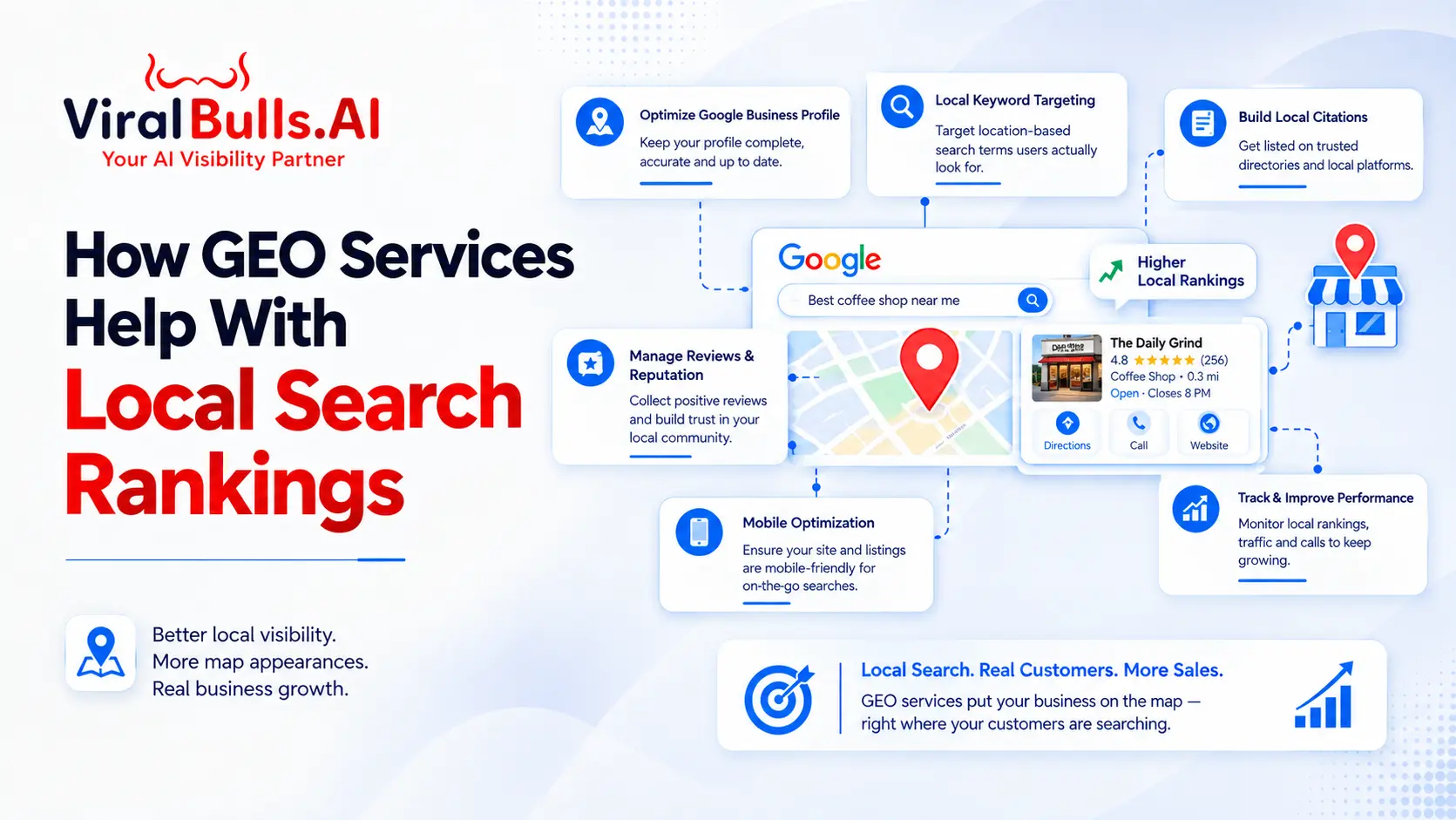
- Google Business Profile optimization
- Location pages
- Local citations
- Customer reviews
- Local backlinks
- On-page SEO
- Technical SEO
- Local keyword research
A GEO strategy can build on that foundation through:
- Conversational query research
- Entity optimization
- Structured service information
- Topic clusters
- FAQ content
- Expert content
- Brand authority development
- AI visibility monitoring
- Third-party mentions
Together, these approaches create a stronger search ecosystem.
Example: Local SEO With and Without GEO
Imagine an orthopedic clinic in Delhi.
Traditional Local SEO Strategy
The clinic optimizes for:
- Orthopedic doctor in Delhi
- Knee replacement surgeon Delhi
- Joint replacement doctor near me
It also optimizes its Google Business Profile, gathers patient reviews, builds local citations, and creates service pages.
This can help traditional local search visibility.
GEO-Enhanced Strategy
The clinic then creates content answering questions such as:
- Who should I consult for persistent knee pain in Delhi?
- Which type of doctor performs robotic knee replacement?
- How do I choose an orthopedic surgeon in Delhi NCR?
- When should joint pain require specialist treatment?
- What should I consider before knee replacement surgery?
It publishes medically reviewed articles, doctor credentials, treatment explanations, FAQs, case information, and structured service content.
Now the clinic has a better chance of being understood not simply as:
“an orthopedic clinic in Delhi”
but as:
“a relevant specialist for particular orthopedic problems in Delhi.”
That level of context is increasingly important in AI-assisted discovery.
Local SEO vs GEO
| Area | Local SEO | GEO |
|---|---|---|
| Primary Goal | Improve visibility in local search results | Improve visibility and understanding in generative AI experiences |
| Search Behavior | Keywords and local intent | Conversational and contextual questions |
| Location Signals | Critical | Important for local relevance |
| Google Business Profile | Essential | Supports broader brand information |
| Content | Service and location focused | Question, topic and entity focused |
| Citations | Local directories and listings | Broader authoritative references and mentions |
| Reviews | Important for local reputation | Can contribute to wider credibility signals |
| Technical SEO | Essential | Still important |
| Human Expertise | Critical | Critical |
| Best Approach | Use with GEO | Use with SEO |
Does GEO Directly Improve Google Local Rankings?
This distinction is important.
GEO itself is not a shortcut or guaranteed ranking factor for Google’s local pack.
Google’s documented local ranking framework emphasizes relevance, distance, and prominence.
A GEO strategy cannot make a business physically closer to a user.
What it can do is strengthen many surrounding signals that also benefit modern search visibility:
- Better content relevance
- Clearer services
- Stronger location context
- Better topical authority
- Greater brand consistency
- More authoritative mentions
- More useful answers
Therefore, GEO should be seen as an additional visibility layer, not a substitute for local SEO.
How Businesses Can Combine GEO and Local SEO
A practical strategy can begin with the following steps.
1. Optimize Your Local SEO Foundation
Make sure your business name, contact information, locations, service areas, website pages, and business profiles are accurate and consistent.
2. Build Strong Location Pages
Avoid creating duplicate pages that simply replace one city name with another.
Create genuinely useful local content.
3. Answer Conversational Questions
Research what customers ask before contacting businesses like yours.
Create content answering those questions clearly.
4. Strengthen Your Brand Entity
Clearly communicate who you are, what you offer, where you operate, and why customers should trust you.
5. Develop Topical Authority
Build interconnected content around your major services instead of targeting isolated keywords.
6. Earn Authority Beyond Your Website
Use reviews, citations, digital PR, industry publications, backlinks, and trusted third-party mentions to strengthen your digital presence.
7. Measure More Than Rankings
Continue tracking rankings and organic traffic, but also evaluate:
- Branded searches
- Local conversions
- Search impressions
- Local leads
- Brand mentions
- AI-generated brand references
- Referral traffic
- Visibility for conversational queries
The Future of Local Search Is Becoming More Conversational
Local SEO is not disappearing.
Businesses still need accurate listings, strong Google Business Profiles, relevant pages, reviews, technical optimization, and local authority.
What is changing is how customers discover businesses.
A potential customer may start with Google, use an AI assistant to compare providers, read reviews, ask follow-up questions, and only then visit a company’s website.
Businesses therefore need to be visible throughout that journey.
GEO services help prepare brands for this environment by improving how clearly their expertise, services, locations, and authority are communicated to AI-powered search systems.
The strongest approach is not:
Local SEO vs GEO.
It is:
Local SEO + GEO.
Traditional local SEO helps businesses become discoverable when customers search nearby.
GEO helps businesses become understandable and relevant when those customers ask increasingly detailed questions through AI-powered search.
At Viralbulls AI, the focus is on combining established SEO practices with AI search visibility strategies so businesses can strengthen their presence across both traditional search and emerging AI-driven discovery.
Because winning local search today is no longer only about ranking for a city keyword.
It is about becoming the business that search engines and AI systems can clearly understand, trust, and confidently connect with the right local customer.