
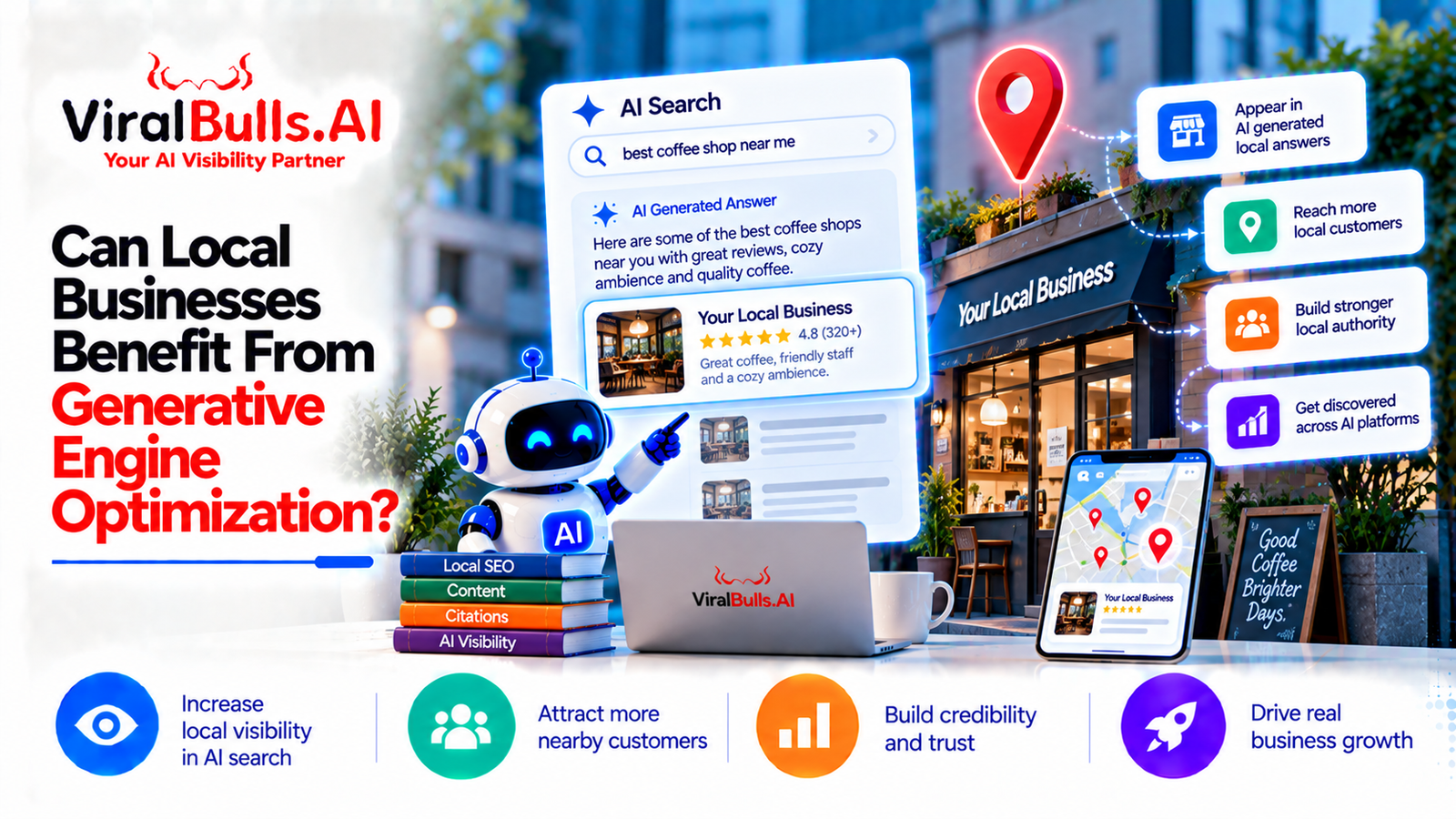
Picture this: a customer types, “Who’s the best salon near me for curly hair?” into ChatGPT, Google’s AI Overview, or Perplexity. Within seconds, the AI names two or three businesses, explains why, and the customer books one. No scrolling. No ten blue links. If your business isn’t in that short list, you simply don’t exist in that moment.
That shift is already happening, and it raises a big question for every shop owner, clinic, salon, restaurant, and service provider: can local businesses actually benefit from Generative Engine Optimization (GEO)? The short answer is yes, and small local players may benefit more than anyone. Let’s break down why, and what you can do about it this week.
What Is Generative Engine Optimization (GEO)?
Generative Engine Optimization is the practice of structuring your online presence so AI-powered search tools can find, understand, trust, and recommend your business. Where traditional SEO aims to rank your page in a list of results, GEO aims to get your brand mentioned or cited inside the AI-generated answer itself.
Think of it as the next layer on top of SEO. The engines have changed: ChatGPT, Google AI Overviews, Gemini, Perplexity, and Microsoft Copilot now summarize information instead of just listing links. GEO helps make sure your business is part of that summary.
Why Local Search Is Changing Fast
Local intent is one of the most common reasons people search: “dentist open now,” “best biryani in Ghaziabad,” “bridal makeup artist near me.” These are high-intent queries, and AI tools are increasingly answering them directly.
Here’s what makes this important for you:
- Fewer clicks, more answers. When AI gives a complete recommendation, users often skip the website visit entirely. Being named in the answer becomes the new page one.
- Conversational queries are growing. People ask longer, more specific questions, such as “Which gym near me has women-only batches and a trial class?”
- Trust decides the winner. AI models lean on signals that suggest reliability: consistent details, real reviews, and credible mentions across the web.
If you’ve only invested in classic local SEO, you’re covering half the picture. GEO covers the rest.
5 Ways Local Businesses Benefit From GEO
1. You Level the Playing Field Against Big Brands
AI answers to local questions favor relevance and proximity over sheer brand size. A well-documented neighborhood business with clear services, strong reviews, and helpful content can be recommended right alongside national chains.
2. You Reach Customers at the Moment of Decision
People who ask AI tools for a recommendation are usually ready to act. Appearing in that answer puts you in front of buyers, not just browsers, which often means higher-quality leads.
3. You Build Authority That Compounds
The work behind GEO, including accurate listings, helpful content, and genuine reviews, also strengthens your traditional SEO, your Google Business Profile, and your reputation. Every improvement pays off in more than one place.
4. You Get an Early-Mover Advantage
Most local competitors haven’t even heard of GEO yet. Businesses that optimize now can become the default recommendation in their area before the space gets crowded.
5. You Turn Your Real-World Expertise Into a Digital Asset
Local businesses know their customers, neighborhoods, and common questions better than any national brand. GEO rewards exactly that first-hand experience when you publish it clearly.
How to Get Started With GEO for Your Local Business
You don’t need a massive budget. Start with these practical steps.
Step 1: Lock Down Your Business Basics
Make sure your business name, address, phone number, hours, and services are identical everywhere: your website, Google Business Profile, Bing Places, Apple Maps, Justdial, and social profiles. Inconsistent details confuse AI systems and lower trust.
Step 2: Optimize Your Google Business Profile
Choose accurate categories, list every service, add fresh photos, and keep posting updates. Your profile is one of the strongest local data sources feeding AI-generated answers.
Step 3: Create Content That Answers Real Questions
Write pages and blog posts that directly answer what customers ask you every day. Use clear headings, short direct answers, and plain language. For example, a clinic could publish “How often should I get a dental check-up?” with a crisp two-sentence answer first, followed by detail.
Step 4: Earn Reviews and Mentions
Encourage happy customers to leave detailed reviews that mention specific services and your area. Also aim for mentions in local directories, news sites, community blogs, and industry listings. AI tools weigh what others say about you, not just what you say about yourself.
Step 5: Add Structured Data
Schema markup, such as LocalBusiness, FAQ, Service, and Review schema, helps machines read your site accurately. It’s a small technical step with an outsized impact.
Step 6: Show Real Experience
Include team bios, case studies, before-and-after results, and local stories. Genuine expertise and first-hand experience are signals both people and AI systems value.
Step 7: Track and Refine
Regularly ask AI tools questions your customers would ask, then check whether your business appears. Note who gets recommended instead of you and study why. Adjust your content and listings based on what you find.
Common GEO Mistakes Local Businesses Should Avoid
- Ignoring your listings. Outdated hours or old phone numbers quietly cost you recommendations.
- Publishing thin, generic content. AI favors specific, useful answers over keyword-stuffed filler.
- Chasing fake reviews. They damage trust and can get you penalized.
- Abandoning SEO. GEO builds on SEO; it doesn’t replace it.
- Waiting for certainty. The businesses that experiment early learn fastest.
The Bottom Line: Be the Business AI Recommends
So, can local businesses benefit from Generative Engine Optimization? Absolutely. GEO gives you a fair shot at being the name AI mentions when a nearby customer is ready to buy, and it rewards the things good local businesses already do well: serving people, earning trust, and knowing the community.
Start small. Fix your listings, answer your customers’ top questions, and collect authentic reviews. Each step makes your business easier to find, understand, and recommend, by people and by AI.
Ready to make your business the answer? Connect with the Viralbulls AI team to build a GEO strategy tailored to your local market.
Frequently Asked Questions (FAQs)
1. Is GEO different from local SEO?
Yes, though they work together. Local SEO focuses on ranking in search results and map packs. GEO focuses on being cited or recommended inside AI-generated answers. Strong local SEO is a solid foundation for GEO.
2. How long does it take to see results from GEO?
It varies. Fixing listings and reviews can show improvements within weeks, while building broader authority and content usually takes a few months. Consistency matters more than speed.
3. Do I need a big budget to do GEO?
No. Many core actions, such as accurate listings, Google Business Profile optimization, FAQ content, and review generation, are low-cost. Professional support helps you scale and measure results faster.
4. Can I guarantee my business will appear in AI answers?
No one can guarantee placement, since AI systems change and don’t disclose exact ranking factors. What you can do is improve the signals that make your business easier to trust and recommend.
5. Does GEO work for service-area businesses without a storefront?
Yes. Plumbers, photographers, freelancers, and home-service providers can define their service areas, publish location-specific content, and collect local reviews to appear in relevant AI answers.
6. Should I stop investing in traditional SEO?
Definitely not. Traditional SEO still drives significant traffic and supplies many of the signals AI tools rely on. Treat GEO as an upgrade to your strategy, not a replacement.