
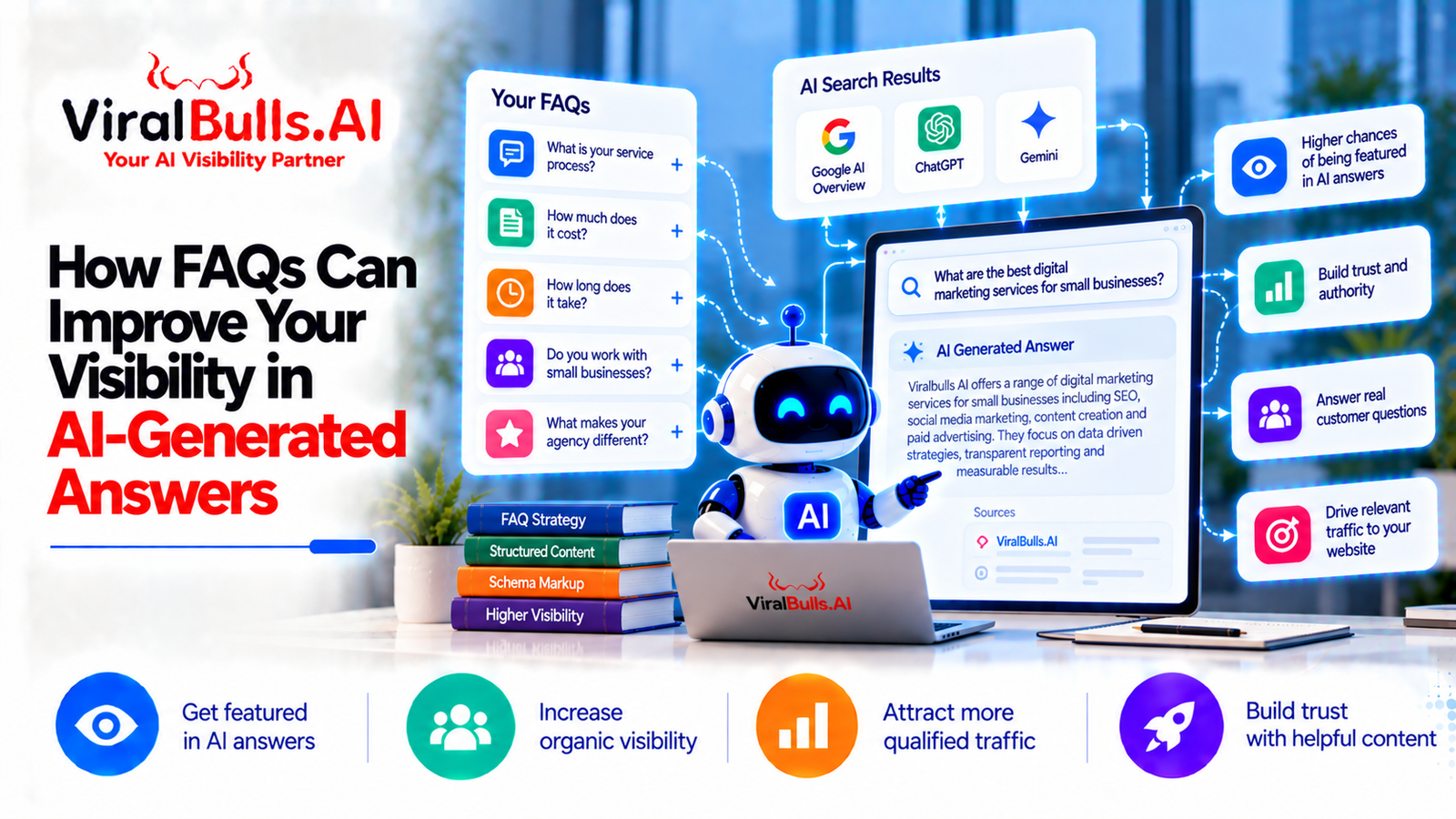
Type a question into ChatGPT, Perplexity, or Google today, and something feels different. Instead of ten blue links, you get one confident, conversational answer with a few sources tucked underneath. If your brand is one of those sources, you have just earned trust, authority, and a click from a highly motivated reader. If it isn’t, you might as well not exist.
Here is the encouraging part: one of the oldest content formats on the web, the humble FAQ, has quietly become one of the most effective ways to get cited in AI-generated answers. In this guide, you will learn why FAQs work so well, how to write them, and how to turn them into a visibility engine for your brand.
Why AI-Generated Answers Are Changing the Visibility Game
Search behavior is shifting from keywords to questions. People no longer type “best CRM small business.” They ask, “Which CRM is best for a five-person team on a tight budget?” AI-powered tools such as Google AI Overviews, ChatGPT, Gemini, and Perplexity respond by pulling information from multiple sources and stitching it into a single, direct answer.
That changes what “ranking” means. Being on page one still matters, but being quoted, summarized, or cited inside the answer matters more. This new discipline is often called Generative Engine Optimization (GEO) or Answer Engine Optimization (AEO), and its central goal is simple: make your content the easiest, most trustworthy source for an AI to use.
This is where FAQs shine.
Why FAQs Are a Natural Fit for AI Engines
AI models are built to match questions with answers. An FAQ page hands them that structure on a plate. Here is why the format performs so well:
- They mirror real search intent. Your FAQ questions echo the exact phrasing people type or speak into AI tools, which makes matching easier.
- They deliver concise, self-contained answers. AI systems favor passages that can be lifted out and still make complete sense.
- They signal clear structure. Question-and-answer formatting helps machines understand where one idea ends and the next begins.
- They build topical authority. A well-organized set of FAQs shows you cover a subject in depth, from beginner basics to advanced concerns.
- They earn trust. Answering objections openly signals expertise and transparency, two qualities both readers and algorithms reward.
In short, FAQs reduce the work an AI has to do. And the easier you make its job, the more likely it is to choose you.
7 Ways to Write FAQs That AI Actually Picks Up
Not all FAQ sections are created equal. A dusty list of generic questions at the bottom of a page will not move the needle. Use these seven practices to make yours count.
1. Start with real questions, not guesses
Mine your customer emails, sales calls, live chat logs, and support tickets. Then check Google’s “People Also Ask” boxes, Reddit threads, and Quora. Tools like AnswerThePublic and Ahrefs can reveal question patterns at scale. The closer your wording is to how people actually speak, the better your chances.
2. Lead with the direct answer
Open every answer with a clear, one- to two-sentence response, then expand with context. Think of it as the “featured snippet” approach: answer first, explain second. AI systems often extract that opening statement as the quotable takeaway.
3. Keep answers focused and scannable
Aim for 40 to 80 words for the core answer, followed by optional supporting detail. Use short sentences, plain language, and bullet points where they help. Avoid jargon unless your audience expects it.
4. Use natural, conversational phrasing
Write questions the way a person would ask a friend. “How much does a website redesign cost?” performs better than “Redesign Pricing Overview.” Voice search and AI chat interfaces both reward conversational language.
5. Back claims with credibility
Include specific figures, dates, examples, and named sources where you can. Add author names, credentials, and “last updated” dates. These trust signals align with Google’s E-E-A-T principles (Experience, Expertise, Authoritativeness, and Trustworthiness), and AI systems lean toward sources that appear reliable.
6. Organize FAQs by topic and place them in context
Do not confine FAQs to one page. Add two to five relevant questions to blog posts, product pages, and service pages, where they support the surrounding content. Group them under clear headings such as “Pricing,” “Getting Started,” or “Troubleshooting.”
7. Refresh them regularly
AI tools favor current information. Review your FAQs quarterly, update outdated answers, and add new questions as customer needs evolve.
Don’t Skip FAQ Schema Markup
Structured data is like a label that tells machines exactly what your content is. By adding FAQPage schema (in JSON-LD format) to your pages, you help search engines and AI crawlers recognize each question and answer pair without guessing.
Keep in mind that Google has limited the display of FAQ rich results in traditional search, so do not expect the old dropdown boxes. Schema is still worthwhile, though, because it improves machine readability and reinforces your content structure. Just make sure the markup matches the visible text on the page exactly.
Common FAQ Mistakes to Avoid
- Stuffing keywords. Forced phrases make answers awkward and hurt readability.
- Writing vague answers. “It depends” with no explanation gives an AI nothing to quote.
- Copying competitors. Generic answers add no unique value, and unique insight is what earns citations.
- Burying the FAQ. Hidden or poorly linked sections are harder for people and crawlers to discover.
- Ignoring your brand voice. Helpful does not have to mean boring. Let your personality show.
How to Measure Your FAQ Impact
Visibility in AI answers can feel hard to track, but you have options. Manually test your target questions in ChatGPT, Perplexity, Gemini, and Google, and note whether your brand appears or gets cited. Watch Google Search Console for growth in question-style queries, and monitor referral traffic from AI platforms in your analytics. Brand-monitoring tools are also emerging that track AI mentions and share of voice. Record results monthly so you can see what is working and double down.
Your Next Step: Turn Questions into Authority
AI-generated answers are not a passing trend. They are quickly becoming the front door to information online. The brands that thrive will be the ones that answer their audience’s questions clearly, credibly, and consistently.
The best part? You already have what you need. Your customers are asking questions every day. Start by choosing ten of the most common ones, write direct and helpful answers, add schema, and publish. Then keep expanding. Each well-crafted FAQ is another chance to become the source AI turns to, and to put your brand in front of readers at the exact moment they are ready to listen.
Ready to make your content AI-ready? The team at Viralbulls AI can help you build a question-driven content strategy that gets you found, cited, and chosen.
Frequently Asked Questions
Q: What are FAQs in the context of AI search?
A: FAQs are structured question-and-answer sections that mirror how people search. AI tools favor this format because it gives them clear, extractable answers to match against user queries.
Q: Do FAQs guarantee that AI tools will cite my content?
A: No, nothing guarantees a citation. FAQs improve your odds by making your content clearer, more relevant, and easier to extract, especially when paired with strong authority signals.
Q: How many FAQs should I include on a page?
A: Quality beats quantity. Five to ten well-researched questions work well for a dedicated FAQ page, while two to five suit blog posts and product pages.
Q: How long should an FAQ answer be?
A: Aim for a direct answer of roughly 40 to 80 words, and add a little supporting detail if it genuinely helps the reader. Keep it concise but complete.
Q: Is FAQ schema still worth adding?
A: Yes. Although Google now shows FAQ rich results less often, schema still helps machines interpret your content and supports better structure overall.
Q: How often should I update my FAQs?
A: Review them at least quarterly, and update any answer when your pricing, services, or industry information changes.